
The Karelian Magic Scarf
1938
Comic opera in one act, in verse
The Karelian farm of Larila
In the foreground, on the left, a veranda-like porch in front of the guest house. On the right, Paraske’s simple but well-kept cottage.
In the background, on the left, the main building of the Larila farm. On the right: a group of outbuildings. However, in the middle of those buildings (that are completely separate so that one can easily walk around them), one notices a kind of windowless shed where the clothes are stored, essentially the vast communal wardrobe of the inhabitants.
In the distance, a road section is half-hidden by wire fencing.
The evening is already advanced (…), at the end of the day at harvest time under the Nordic sky.
The scene takes place in Karelia, a land of traditions and old songs, located in southeastern Finland. The epilogue scene shows a village in the southwest.
Larila, Mathieu, Okuline, and the harvesters are seated around a large table laden with food, placed in the center of the stage; the meal is about to end.
Period: Circa 1870
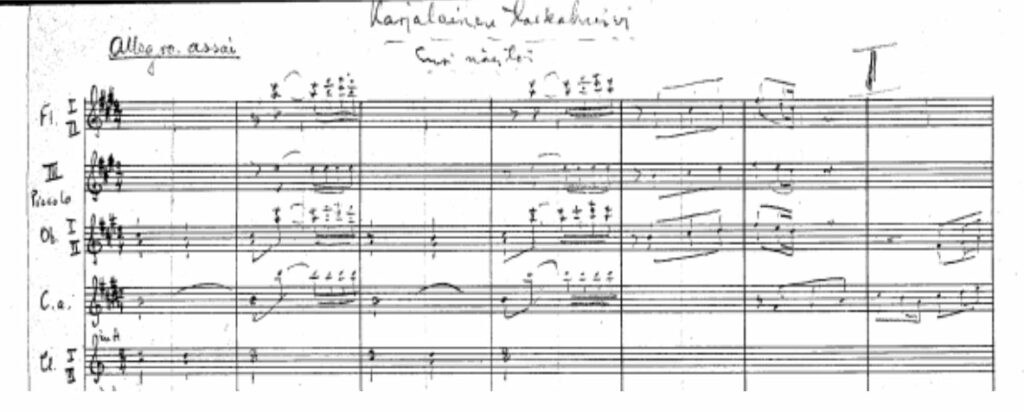
Extract from the handwritten 63 pages manuscript .
_______________________________________________________________________
In his unpublished 1937 opera, Karjalainen taikahuivi (The Village of Karelia), Launis returns to Karelian and Ingrian melodies. The work’s main themes originate from his earlier travels to Karelia, Ingria, and Estonia to record folk songs. This opera, dramatic in nature, tells a comic love story centered on the coincidences that occur in a small Karelian village around an enchanted silk scarf. The composer’s self-portrait is found in the role of Lingén, the retired postmaster who, as a collector of magic and traditional knowledge, dreams of a bygone era in the magical lands of Karelia. The renowned Ingrian rune singer Larin Paraske also appears as an operatic character, here as a young widow in her thirties. Launis adapted the four-part Karelian Suite from the opera’s music.
©Wikipedia

