
Three-act opera, composed in 1922.
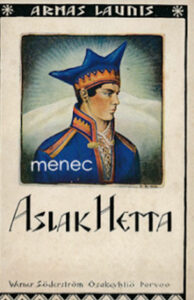
Libretto by the composer, the melodrama at the beginning and the song of the Maiden of the Day are based on Larin Kyösti’s poem Aslak Hetta (1909).
3332 4331 12 1 strings, choir and soloists
Original performance and recording (Finlandia, RSO, Sakari Oramo, ONDINE – ODE 1050-24)
Introduction
In 1922, Armas Launis made his third trip to the Lapland of his youth, this time among the Skolt Sámi and with his wife Aïno. The same year, his book Kaipaukseni maa (The land of my longing) has just been published and Armas Launis has composed Aslak Hetta. But the creation of the opera was delayed because of the demanding nature of its vocal parts. In the mean time, Launis had the libretto translated into French, German and Italian, and the printed piano score published in 1930. The premiere was held as a concert performance at Finlandia Hall in 2004, after the handwritten score had been edited with the help of grants from Finnish cultural foundations.
The opera tells the story of Aslak Hetta, the national hero of the Norwegian Sámi, who led a disastrous uprising against the country’s main people in 1852. Launis has mixed facts and fiction in the story – the romantic plot includes the tragically ending love story between Aslak and a Finnish girl, Agni.
The opera is more dramatic than the previous two, and its premiere in Helsinki received unanimous praise from critics. The music is influenced by Wagner, Strauss and Puccini, but the particular effect in the musical language comes from the archaic Sámi yoik melodies that Launis has inserted as leitmotifs. Indeed, the young Launis had notated 800 yoiks during his collecting trips (Lappische Juoigus-Melodien, 1908), which still play a significant role in the study of the indigenous peoples’ music. Both the musical and dramatic dimensions of the opera are increased by a group of religiously fanatical shouters.
Libretto
The libretto by Armas Launis is based on the failed Sámi uprising that took place in Norwegian Lapland in 1852, whose leaders have been executed. Launis adapted the events and added fictional elements.
Plot
The settings are the shaman Lanni’s hut in Kautokeino and the Kautokeino church village.
Characters: Nalta Lanni, famous shaman (bass), Aslak Hetta, Lanni’s adopted son (tenor), Unna, Lanni’s daughter (soprano), Agneta, Finnish traveler (mezzo-soprano), Agni, her niece, the betrothed of the bailiff Bucht (soprano), Nilla Staggo, Sami lay preacher (tenor), Henrik Lyckselius, parson (bass), Amund Bucht, the bailiff (baritone), Hans Ruth, merchant (tenor), Kadja Joussa, the bailiff ‘s servant (tenor), a Norwegian officer (baritone), two reindeer herders (alto and bass), the voice of a shouter (tenor), narrator (speaking role).
Act 1
On their way to Koutokeino church, Agneta and Agni arrive at Lanni’s yard. Aslak, who dreams of freeing his people from the Norwegian rule with the help of the shouters, a fanatical religious sect, promises to be their guide the next day. A group of shouters visit their hut and burn their holy books. Aslak confesses his dream of liberation to Agni. Agni immediately feels a strange attraction to Aslak. Lanni, who has knelt before the Sámi stone god and hopes that Aslak will marry his daughter Unna, repeats his spells.
Act 2
Agni has arrived at the village with her aunt, where the merchant and the parson have also come to the betrothal of the bailiff and Agni. The villagers celebrate with numerous toasts, and things are getting more and more rowdy. Agni notices that her feelings for the bailiff have cooled and leaves to join Aslak. Aslak explains his plan to Agni. Agni, who fears the worst, wants to prevent the rebellion and sends a message of warning to the Norwegian garrison. The shouters arrive, capture the Norwegians and set fire to the bailiff’s house, ignoring Aslak’s attempts to restrain them.
Act 3
Lanni has gone to seek advice from his ancestors in a deep trance and has been ordered not to shed blood. Aslak also agreed to a peaceful solution. Agni tries to free the Norwegian prisoners. Aslak thinks Agni has betrayed him and pushes her away. At daybreak, Lanni and the shouters arrive. They want to execute the prisoners and also kill Lanni and Aslak, who have refused a blood shed. Norwegian soldiers, warned by Agni, arrive and a fight breaks out. The soldiers crush the uprising and Aslak pays with his life for his attempt. Agni, wounded in the battle, falls dead next to Aslak’s body. The tragedy of the opera is emphasized by the misunderstanding that arises between the lovers at the end.

