
Once upon a Time
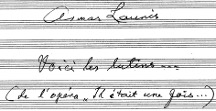
A fairy-tale opera in three acts, with a prologue and an epilogue.
Composed in 1944 (piano score). Text by Armas Launis.
In the land of Maigrelande, long ago, the church bell in the capital, Tourvieille, cracked on the very day of the king’s death. The shrill sound of the cracked bell made people laugh, happiness vanished, and a wave of unrest gradually arose. The young prince fled to a remote village, Vilaforge, where he was known only to a few, and took refuge with one of his supporters, the master blacksmith Braffort. In Vilaforge, weapons were being made for the king of Terrabonde, whose country was in the vicinity. The sacristan, Gaspard, came and told the skeptical villagers, in his own way, how the bell had mysteriously cracked. The handsome prince, known only as Gaiferrant, caught the eye of the village’s young beauties : each of them tried to get close to him and be noticed by him.
Then comes Flore, a poor woman, who sings, accompanied by her father, an itinerant harpist. Gaiferrant asks Flore to operate the bellows at the forge. Afterwards, Flore sings the ballad of a prince who seeks happiness and finally realizes thaThen comes the priest, who, through his modesty and generosity, enjoys great popularity. He announces to Braffort that the prince’s supporters have raised money for a new bell, which he is going to buy. The King of Terrabonde, accompanied by his daughter Clothilde and his retinue, arrives in a grand procession. He acts as if he were already the master of the land and promises the people every possible happiness. He is received with eagerness. But when his supporter, the innkeeper, informs him that the priest is going to buy another bell, the king continues on his way, arriving in the city before the prince has received the new one. Upon learning this, Gaiferrant also decides to return to his capital.
The traveling musician and Flora arrive at the inn near the Pine Pond.
We learn that he is the Duke of Celymar, invited by the late king, who has come to bring his daughter to the prince so that she may marry him. But because of the uncertain times, they have taken on these disguises. The duke already believes his journey is in vain. Flora is enthralled by the summer beauty of nature; she imagines she is a bellflower and invites the meadow folk (flowers, mushrooms, insects) to dance in a circle with her, while the meadow orchestra plays (cicadas, grasshoppers, toads, bells, etc.).
The king and his daughter arrive. They eat lunch, satisfied that their journey seems to have been a success. But suddenly, they are frightened by the overhearing of the innkeeper and his wife arguing about the pigs they are to slaughter. Frightened, and believing the argument concerns them, the king and his daughter consider fleeing. But they think it wiser to first exchange clothes with the beggars present. Shortly after, the priest arrives. The king judges this the right moment to obtain from the priest the purse intended for the purchase of the bell. He manages to move him by speaking of his son, a war prisoner, who will be killed if a ransom is not paid. The priest gives him his purse, and the king, overjoyed, presents it as a dowry to Flora, then continues on his way with his daughter. Gaifferant arrives and recognizes his friends, the vagabonds, dressed in royal robes. Flora invites him to take part in the grand court ballet offered by Nature. Then Gaifferant declares that the tale continues and asks for the hand of “Princess Campanule.” The duke hesitates to take a blacksmith as a son-in-law, but the latter hopes to soon obtain a kingdom. The blacksmith prince learns with surprise that the purse of bells is in Flore’s hands. The three of them set off to find a kingdom for Gaifferant.
The priest, hearing the cracked bell ringing in the distance, begins to deeply repent. The money did not belong to him. Frogs come up from the pond and croak reproachfully at him. Gaspard arrives and consoles him, assuring him that he will arrange everything by giving the people a reason for the delay. At first, the priest calms down and hears the cicadas; but thinking of Gaspard’s future lies, he grows somber and hears only the croaking of the frogs. Sad, the priest walks away, followed by Gaspard. It’s raining, and the sound of thunder can be heard in the distance.
In the Tourvieille town square, Gaspard’s lies about the bell are stirring up doubts. People are turning away from the priest; everywhere he goes, children mock him. Even the frogs are croaking reproaches at him. The King of Terrabonde, pleased with the turn of events, is preparing to take the land of Maigrelande. People already support him almost unanimously, but the Prince, also confident in his luck, aided by Braffort, is making his final preparations.
Flore hasn’t seen Gaiferrant since arriving in the capital, and, overcome with grief, she sings. The little bells will come to console her when the wicked Catherine, her rival, claims that Gaiferrant has turned his attention to a richer woman. Braffort arrives and announces to Flore and her father that the Prince is calling for her. But Flore, unaware that the Prince and Gaiferrant are one and the same, does not answer the call. Against her father’s wishes, she only wants to find Gaiferrant.
People demand an explanation from Gaspard for his lies and would hang him if the priest did not intervene in time to defend him. The situation becomes so chaotic that the priest decides to confess his wrongdoing and tell the truth. But at that moment, the clear sound of the bell, which the Prince had secretly acquired, is heard from the top of the bell tower. The gates of the royal castle open, and the Prince, followed by his escort, appears in his royal robes. He announces that he has chosen a Queen for his people. Braffort leads Flore, surprised and hesitant, before the prince, the people acclaim the royal couple, sing a hymn in honor of the new bell and, amidst the acclamations, the royal couple enters the church : the door are wide-open and the music of organs can be heard.

