
Opera – Three acts
Composed in 1917
3332/4332/12/1/
strings, soloists and choir
Presentation
Launis always wanted to be an opera composer. After The Seven Brothers, he became interested in the theme of Kullervo.
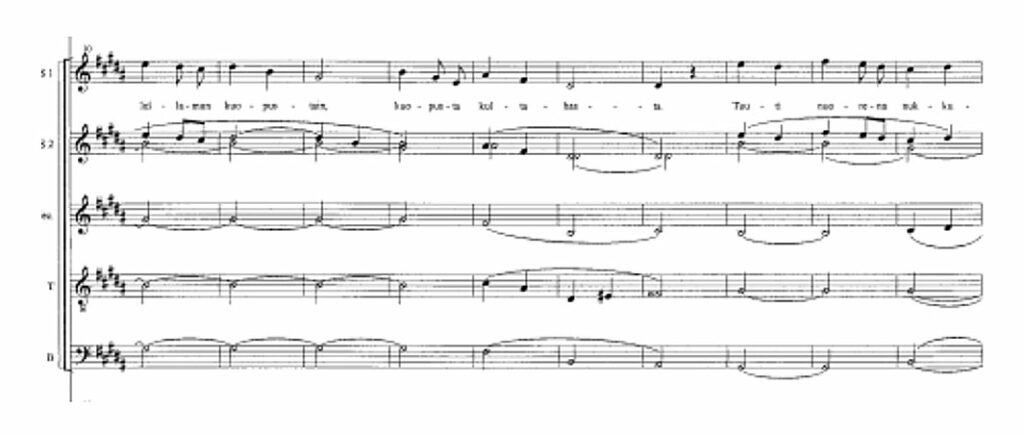
The musical language of the arias in Kullervo represents the national romantic style. It is reminiscent above all of the music of Toivo Kuula or Oskar Merikanto. The opening shepherd’s horn solo and the calls at the beginning of Act II were influenced by experiences gained during the collection of folk melodies.
In Kullervo, the composer gives more prominence to vocal elements, and there are subtle details in the vocal parts of the mother, for example. Launis employs the leitmotif technique to some extent, and, for instance, the Lullaby has a leitmotif announcing reconciliation. However, the composer often departs from Wagnerian unity, as there are separate pieces, such as the Dance of the Blue Maidens, Nyyriki’s Drinking Song, Ajatar’s Spell, and the Goblin Festival at Untola.
In this opera—as in almost all of his works—there is a strong folk music element; in his first two operas, the tone is Finnish, and in later operas, the influences come from the folklore of various nations.
Libretto
The text by Armas Launis is based on Aleksis Kivi’s play Kullervo (1864), the Kalevala, the Kanteletar, and Eino Leino’s verse play The Swan of Tuonela (1898).
Plot
Characters : Kullervo, slave of Ilmari (baritone), Kimmo, slave of Ilmari (bass), Kalervo, father of Kullervo (bass), mother of Kullervo (mezzo-soprano), Ainikki (silent role) and Kelmä, sisters of Kullervo (soprano), Unto, brother of Kalervo (silent role), Ilvo, mistress of Ilmari; Kullervo war comrades Tiera (comic bass), Käpsä (tenor), Viksari (baritone) and Tiimanen (tenor); Nyyrikki, birdcatcher (comic tenor), 1st man of Ilmari (baritone), 2nd man of Ilmari tenor), elves: Sinikki (soprano), Tuulikki (soprano) and Tellervo (alto); Evil People: Ajatar (alto), Remunen, Maiden of Death, Syöjätär, Turja, and trolls (speaking roles); elves, nymphs, servants of Ilmari, men of Unto, and other people.
The action takes place on a wooded hill near Ilmala, at Kalervo’s farm by Lake Kalalampi, in the courtyard of Unto, and in a forest near Unto.
Act 1
Due to an old feud, Kullervo, son of Kalervo, was sold into slavery. Kalervo’s brother, Unto, destroyed his family, and Kullervo vows revenge on his uncle. Kalervo’s old slave, Kimmo, advises him against murder and reveals that he once took his revenge by secretly assassinating one of Unto’s men. Kullervo’s confession of the murder enrages him, and he threatens to strangle Kimmo. Kimmo manages with great difficulty to calm him down, and Kullervo rejoins his herd.
Kimmo learns from the bird-catcher Nyyrikki that Kullervo’s parents are still alive in a distant forest. While eating, Kullervo breaks his knife, his only memento of his father; Ilmari’s mistress had put a stone in his bread. Thirsting for revenge, Kullervo invokes Ajatar, the evil spirit of the forest, who, with incantations, unleashes wild beasts upon Ilvo’s cattle (“Arise, forest, with your cattle”). Ilvo violently berates her, and when, in her anger, she calls Kullervo a slave, he beats her to death and leaves the country.
Act 2
Kullervo’s family ekes out a living in abject poverty in Kalalampi. Ainikki, one of their two daughters, has disappeared. The other, Kelmä, arrives full of hope as the neighbors come to help with the search. Kelmä tries to remember her sister by singing the aria (“We Are Two Beautiful Ones”), which is then sung in chorus by her father and mother. Kullervo arrives at his parents’ house without knowing who they are. He confesses to his crime, and thanks to Kimmo’s testimony, the horrified parents recognize their son in this murderer. Tenderness overcomes the mother. She takes her son in her arms and sings a lullaby (“My beautiful treasure, curly-haired and blond…”). When the furious father chases Kullervo away, he confesses to another crime. He has, unknowingly, dishonored his sister. At the same time, the body of a young girl who threw herself into the water and drowned is brought in. The mother then begins to sing a funeral dirge in a low voice. The crowd joins in the lament with fervor (“My image is dead”). Kullervo, cursed by his father and sister, goes off to war despite his mother’s pleas. He seeks revenge, for the source of all his misfortunes, Unto, is still alive. After his departure, his grief-stricken mother dies in Kelmä’s arms.
Act 3
Kullervo carries out his threat of revenge: he kills Unto and burns his house. But the joy of vengeance turns to horror. In the reflections of the flames, he sees all his crimes. Tormented by remorse, he leaves and returns to the scene of his first crime. He draws his sword and, lulled by his mother’s lullaby, stabs himself.
Performance
First performed at the Finnish Opera on February 28, 1917.
Adapted into French and conducted by Charles Boisard, the opera was broadcast by Radio-Nice PTT on July 30, 1938. It was then premiered in Nice on February 22, 1940, at the Palais de la Méditerranée, conducted by Henri Tomasi and directed by Marcel Sablon, at a benefit gala for Finland, then at war with the Soviet Union. That was the first Finnish opera performed in France. On October 22, 1947, Charles Boisard conducted Kullervo on Radio Monte-Carlo.

