
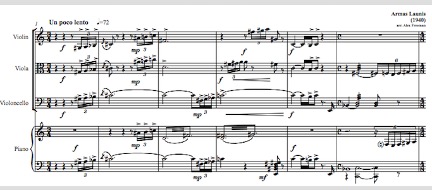
Opera in three acts, composed in 1940, libretto by Armas Launis, translated into French and German.
3332 4331 12 1
Strings, celesta, xylophone, chorus, ballet, narrator, and soloists.
The manuscript has been reconstructed by the Armas Launis Society.
The opera was partially broadcast in France on Paris-Inter radio on January 13, 1954, conducted by Eugène Bigot.
Introduction
Passionate about musical ethnology, Launis made several trips to North Africa. He became interested in ancient Arabic music, also known as Andalusian music, and listened to singers and folk musicians among the Berbers, Bedouins, and nomads he encountered in the Sahara. He also heard primitive violins such as the kamendjeh and the qanun zither, similar to the Finno-Baltic kantele. He sought to put his knowledge of Eastern life into practice in both his book, Murjaanien Maassa (In the Land of the Moors), and his lyrical work, Jehudith. This rare subject, set against a biblical backdrop and depicting Bedouin life at the beginning of our era, is a moving drama born from the author’s imagination. It features a Bethlehemian Jehudith, the mother of the good thief of Golgotha, who was, in a way, also a “mater dolorosa” at the foot of the Cross.
The libretto, written in 1937 and translated into French by Pierre Rose, was published in 1940, with a preface by the composer and conductor Henri Tomasi. In the final score, the French translation is by the conductor Charles Boisard.
The score, very different from his earlier works, has an oriental feel.
Libretto
Libretto by Armas Launis, inspired by biblical stories and the legends of the Flight into Egypt of the Holy Family.
Plot
Characters: Shimron, chief of the Bedouin tribe (bass), Jehudith, his wife (soprano), Dismas, their young son (silent role), Hagar, Shimron’s mother (alto), Ham, an elderly Black slave and governor (baritone), Gesmas, a young Bedouin (tenor), Cassium, a Roman centurion (baritone), Joseph, a Nazarene (baritone), Mary, a Nazarene (mezzo-soprano), the infant Jesus (silent role), the narrator (speaking role), members of the tribe, Roman soldiers, a chorus, and a ballet.
The action takes place in a Bedouin encampment in the desert, approximately one year after the birth of Jesus.
Act 1
The tents of a Bedouin tribe in the desert, at the foot of a mountain. Shimron and his mother Hagar bring a lantern and light it. They intend to lure the poor, lost souls of the desert into a trap.
Gesmas, a young Bedouin, asks Jehudith to flee with him. This keeps postponing their departure. His son Dismas, a leper, has been infected by his nurse, who has just died.
Hagar accuses her son of stealing from Jehudith, the Jewish woman, whom she holds responsible for all their misfortunes. Shimron listens to Jehudith’s version of events: Hagar herself chose that nurse, knowing she was sick, and their son is doomed. A violent argument breaks out between Jehudith and Hagar, she seizes a poisoned dagger and tries to stab her daughter-in-law. Shimron separates them.
The sound of trumpets is heard. Cassius, a centurion with his Roman soldiers, surrounds the tents, searching for the couple and the young child who might be the King of the Jews. He explains to them that wherever this family goes, nothing will stand in their way. Magical forces seem to guide their steps, and the wild animals calm down…
Simron shows the Romans the path the refugees might have taken.
The soldiers leave the tribe and disappear into the night.
The chief’s family settles down by the fire to eat.
Act 2
Hagar keeps snakes in her basket, which immediately stir at the slightest anticipation: the arrival of guests, a sandstorm… She confides to Shimron her hatred of the Jews, who once refused her hospitality. The storm rages, and the snakes become increasingly agitated. A couple and a young child arrive. Shimron and Hagar plan to demand a ransom and consider the amount to ask. Jehudith demands that Shimron prepare a bath for the child.
Act 3
Jehudith and Mary bathe the child; what if he were the King of the Jews, Jehudith wonders. She then immerses Dismas in the water. He is healed. Grateful, Shimron decides to help Mary and Joseph escape. Gesmas still wants to be free of Dismas. To protect her son, Jehudith seizes a poisoned dagger, tries to resist, and is wounded. The poison slowly begins to take effect. Jehudith confides in Mary and tells her about her life and the prophetic vision: on a high hill stand three crosses, symbols of reconciliation.
Simron frees the fugitives and promises to let them escape the Roman soldiers.
Joseph, Mary, and the King of the Jews leave.
Jehudith collapses and takes her own life..

