
THE MARTYR AND THE WHITE FATHER
In this opera, Launis recounts the martyred fate of a young woman buried in the catacombs of Sousse. The narrative unfolds as a dream, that of a White Father participating in the excavations at this site.
The action takes place in Sousse during the time of ancient Hadrumetum.
Left unfinished, this opera was never performed.
Opera in three acts
1939
four scenes and an epilogue
White Father, an old man with white hair, dressed in a white burnous, is both the curator and guide of the underground tomb in the ancient southern Tunisian city of Hadrum, and, having taken part in the excavations, is deeply attached to this work. Appointed to another position, he must leave. From a tomb, where a martyr may have been buried, he kept a piece of skull and half a jawbone, and these remains cause him great concern.
A Bedouin woman, Khadra, manages to learn of the secret existence of the hidden bones and steals the seven teeth from the jawbone from Father White to attract a “baraka,” an irresistible power. According to Bedouin superstitions, the guardian, from whom the bones were stolen, senses and sees extraordinary things; while the deceased to whom the bones belonged lives again with his loved ones.
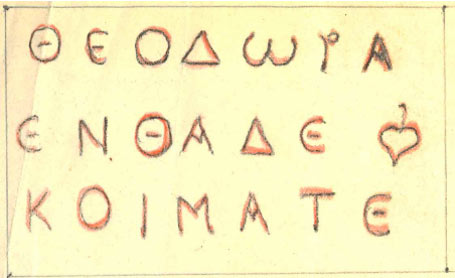
Father White leads tourists through the underground vaults, showing them the tombs. He recounts that when the tomb of Theodora, of Greek origin, was opened, traces of fire were found on the bones, along with a broken skull; the plaster cast on her chest bore the imprint of a bouquet of roses, perhaps red roses.
As evening approached, the Bedouins, led by Khadra, entered the underground chamber to steal the remaining teeth belonging to Theodora. Father White arrived. They stopped him and tried to force him to reveal the tomb’s location, threatening to bury him beneath the vault. The letters on Theodora’s tomb suddenly lit up, and the tomb itself revealed itself. Khadra began to open it. But the vaults of the side underground chambers collapsed, and all the Bedouins fled. Father White wanted to stay and guard the underground chamber. He feared the Bedouins would return; he heard cries in the distance: Saïd was trapped under the rubble. Father White freed him and then fell asleep.
He saw the inhabitants of the underground chamber appear. He recognized Theodora among her friends. He followed them to see Theodora’s childhood home.
Spring was being joyfully celebrated in the palace of Theodora’s mother, the widow of a Greek nobleman. Besides Theodora and her friends, and the lady of the house, those present included the Prefect, the centurion Longinus, and his adopted son Zotice, dressed as a Berber tribal chief. They played the game of the rose. Happiness fell to the one who received the red roses. It was Theodora. The parents proclaimed the engagement of Theodora and Zotice. The Prefect asked Theodora to offer her roses to Aphrodite, who had wished her happiness. Unable to refuse, Theodora removed a scarf from her shoulders, bearing a Christian symbol, and covered the statue with it so that the symbol was visible. She then laid her flowers there, thus confessing her Christian faith. After a heart-wrenching scene in which Zotice and the Prefect begged her to atone for her actions, the guests left the palace, and Theodora was led away, bound.
Night has fallen. The body of the young martyr Theodora, who died in the arena, lies on a bier in the middle of the atrium. Her parents and friends sing as they keep vigil over her; the Bedouins who were her friends show their sorrow and bid her farewell. Zotice places red roses on Theodora’s chest.
The bier is taken away.
At dawn, Father White emerges from the underground chamber, deep in meditation. He contemplates Theodora’s bones, which he now knows to be sacred. Saïd arrives and announces that his tribe promises to respect the underground chamber from now on and will ensure that others do the same. Khadra brings Father White the teeth she stole as thanks for saving her son. Father White can now leave.

