
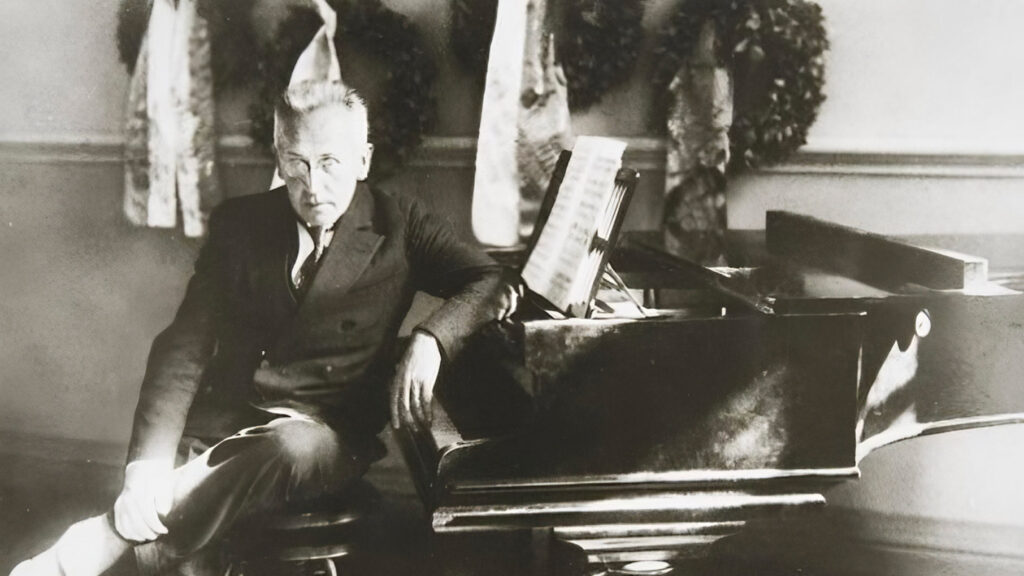
At the beginning of July, the Organ Night and Arias Festival will offer the world premiere of the TV ballet opera Frozen Flames, sixty years after Armas Launis composed it, in 1957.
The last opera of the Finnish composer Armas Launis (1884-1959), Frozen Flames, sheds light on the artist’s inner world. The theme of the opera can be interpreted as the composer’s last and longing look at the homeland of his youth, after he settled in Nice. While the work, inspired by antiquity, looks to the past, it also anticipates a new era and the composer’s enthusiasm for modern technology.
Armas Launis was a pioneer. He composed the first Finnish comic opera, The Seven Brothers (1913) in which he introduced spoken word singing – which was still shunned by his contemporaries – because he wanted the singers to achieve a natural and folk-tinged expression.
His second opera, Kullervo (1917), was a big success and earned the composer an artist’s pension, an annual state grant for artists. With this financial support, he was able to travel to learn about the cultures of different countries, to search for unusual themes and collect folk culture materials for his operas.
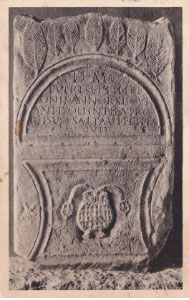
An old Roman memorial stone found in Antibes and the inscription engraved on it inspired Armas Launis to compose the ballet opera Les flammes gelées (Frozen Flames), designed for television.
Content of the writing: A place sacred to the gods of the underworld, where a 12-year-old Nordic boy rests. For two days he danced at the Antipolis theater and pleased the audience.
Launis was an avid explorer and experienced scientist. In Border Karelia and Ingria, he recorded folk melodies with a phonograph. He was the first Finnish musicologist to defend his thesis on folk music : his dissertation (1910) dealt with Estonian rune singing.
Armas Launis was a curious innovator by nature. His sense of time is revealed by the fact that he planned to show short film sequences to illustrate the overtures and interludes of the Aslak Hetta opera, a Sámi-themed opera composed in the 1920s: “Lappish landscapes in the morning light”, “Two reindeer herders passing by with their herd, moonlight”.
Launis’ interest in new technologies is revealed in his last opera, Les flammes gelées (Frozen Flames, 1957), which he completed two years before he died. It was designed for choir and orchestra, but he did not have the time to transpose the piano score into an orchestra score. The work aroused interest in Nice. The libretto of Frozen Flames was published in a Nice evening newspaper in a series of three articles. The director of Nice Radio also expressed interest in performing the work first on the radio and then on television.
Launis also gave the names “Stella borealis” and “Septentrio, Paksen poika” to his work. The one-act work has, in the composer’s words, twelve “visions”. It was the first Finnish ballet opera of its kind written for television.
The goal is a holistic art experience.
In the opera’s story, based on an old Roman theme, Septentrio, the 12-year-old son of a Nordic Viking chieftain, is captured by the Romans in Brittany. He dreams of returning to his homeland guided by the birch and the North star. He boy achieves such great success with his dance that he is freed from slavery. However, unaccustomed to the southern climate, he falls ill and dies.
Armas Launis’ life story, reflecting longing for his northern homeland, and his versatile musical language create an atmosphere that embodies his desire for a holistic artistic experience : it combines music with visuals and dance.
Where did Launis get the idea for his work? In 1930, he and his family settled permanently on the Mediterranean coast in Nice. While visiting the Antibes Archaeological Museum, located next to his new hometown, he saw an old Roman tomb or memorial stone. On it was engraved the story of the slave boy Septentrio: the boy had enchanted the audience with his dance for two days and then died. The story obviously had a strong impact on Launis. It expresses longing, deeply hidden feelings and love for the land of his youth.
The Organ Night and Aria festival will not feature a dancer, but a video work. The direction and video design are by Valtteri Raekallio and Thomas Freundlich.
“From a modern perspective, it seemed inappropriate to perform Launis’ work faithfully to the libretto, to its parentheses and to the characters’ descriptions” says Raekallio. “Launis’ musical conception has stood the test of time better than the dramatic structure of the work or the characters’ descriptions. The music remains relevant and inspires new interpretations.”
Raekallio and Freundlich have taken significant artistic liberties with the original TV ballet opera. They state that their aim is to create a concert performance that is built from elements of contemporary art and that hopefully all this will continue “Launis’ search for the new.”
“Our aim is not to illustrate the drama of the libretto. Alongside Launis’ music which holds a central part, our most important tools are a large video projection and the concrete-brutalist Tapiola Church – designed by Aarno Ruusuvuori – and the possibilities offered by its acoustics, for example in the placement of the choir. They are in constant dialogue with each other,” says Freundlich.
The Helsinki Chamber Choir, conducted by Nils Schweckendiek, performs the music. The choir moves on the stage, but it does not “perform” any narrative role. The choir forms a community in which the solo voices are reflected and bring their own special color to the performance.
In a performance lasting over an hour, Armas Launis’ original ideas are presented, adapted to a modern form, in a very Launis-like, innovative spirit.
Armas Launis’ opera Frozen Flames will be performed at Tapiola Church in Espoo on July 2 at 8 p.m. (world premiere). The performance language is French. Before the performance, at 7 p.m., a discussion about Armas Launis and Frozen Flames will be held.
PEKKA HAKO
© RONDO 4/2026 Traduit du finnois

