
On the occasion of the premiere of the opera Frozen Flames, Sébastien Cagnoli offers here an illuminating text on the historical context of this work and its protagonist, Septentrion.
A writer and translator (recipient of the Finnish State Prize for Translation, 2025), as well as a researcher in Finno-Ugric and Occitan languages and cultures, he has organized trilingual concert-readings in Helsinki and Nice based on texts by Uuno Kailas and music by Armas Launis, in collaboration with our society.
Although Armas Launis (1884–1959) achieved a measure of success with his first two operas—Seven Brothers (1913) and Kullervo (1917), which earned him the honour of a lifetime pension from the young Republic of Finland—his later works, most of them composed in Nice, have not been performed during his lifetime, with the exception of an abridged version of Jehudith (1940), broadcast on the radio in 1954. His Sámi opera Aslak Hetta (1922) was not performed until 2004, in a concert version. The premiere of his final work is therefore an exceptional event: the opera-ballet Frozen Flames (1957) will be presented to the public on July 2, 2026, at the initiative of the Armas Launis Society and the Urkuyö ja Aaria festival, in collaboration with the Helsinki Chamber Choir and Raekallio Corp.
In the 1950s, Launis conceived this project as a televised opera-ballet. Opera was his preferred medium (It was already his tenth work in the genre), television was an emerging technology, and, as will be seen, the choreographic dimension was self-evident. Indeed, this production invites us to immerse ourselves in the context in which Frozen Flames was conceived and to return to its source: aRoman stele, preserved at the Antibes archaeological museum, which inspired this work by Launis.
1. The stele
The stele known as “The stele of the child Septentrion” has been documented since the 16th century. The modern city of Antibes, in eastern Provence, developed on the site of the ancient Greek city of Antipolis. Greek merchants settled there around the 4th century BC among indigenous Ligurian tribes, and the region was annexed to the Roman Republic around 43 BC.
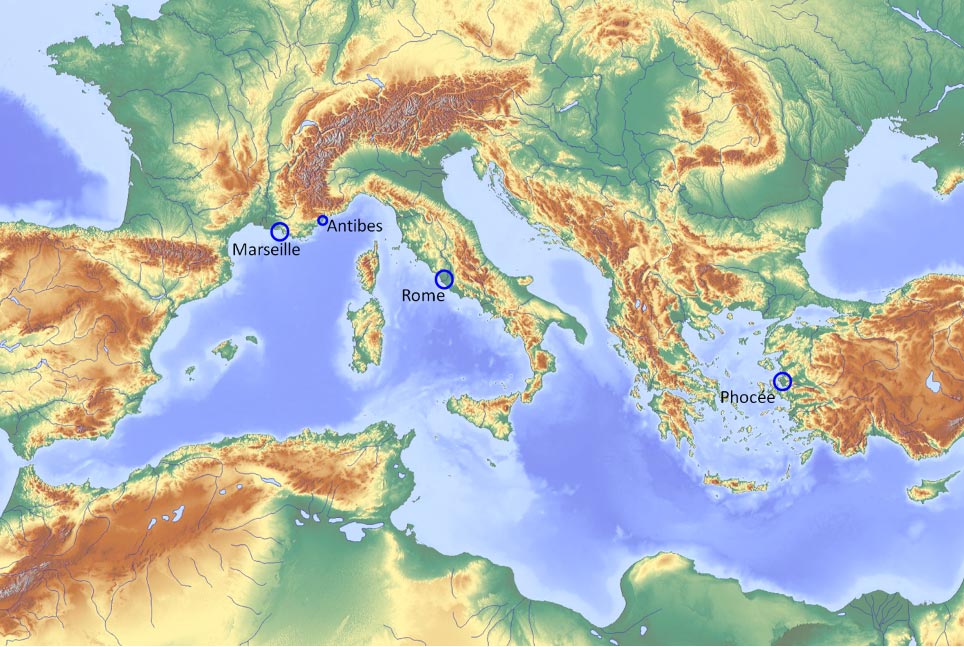
Mentioned as early as 1558 in a scholarly work[1], the stele was then located “beside the bread oven” and is said to have been discovered in 1542 within the foundations of a wall. It is a reused limestone slab, probably recovered in the Middle Ages from a former local necropolis; its original location remains unknown.
In 1928, a museum of history was established in Antibes within the Grimaldi castle, a former seigniorial residence. The stele was installed there and became the first archaeological object recorded by the museum [2]. It was there that Armas Launis discovered it most likely in the 1950s[3].
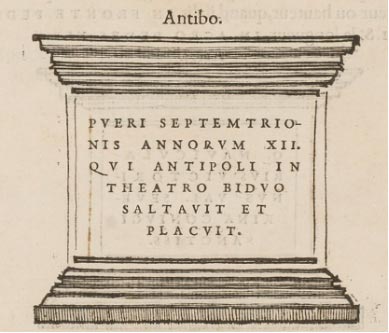
The stone, measuring 113 × 75 × 26 cm, is a stele—that is a monument intended to mark the location of a grave [4]. The inscription is a Latin epitaph:
DM
PVERISEPTENTRI
ONIS ANNOR XII QVI
ANTIPOLI IN THEATRO
BIDVO SALTAVIT ET PLA
CVIT
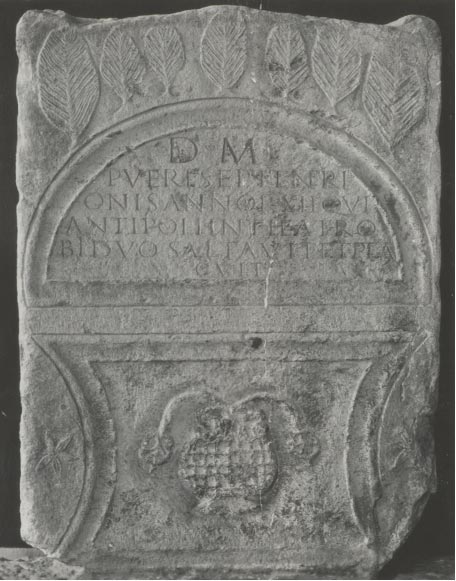
Epigraphic analysis has made it possible to decipher and date it to the 3rd century.
D(is) M(anibus) To the Manes
pueri Septentri- of the child Septentrion
onis annor(um) XII qui aged 12 who
Antipoli in theatro in Antibes, in the theatre,
biduo saltavit et pla- for two days danced and
cuit pleased [5].
The word puer refers to a “child”, but a slave child, with no family name, no citizenship. At first sight, this stele is therefore a stone indicating the tomb of a young slave, a dancer, dead at the age of 12.
2. Septentrio
For Armas Launis—and for us today—Septentrio signifies the North. In Latin, septentrio originally refers to the constellation of the Ursa Major, more specifically the Big Dipper, with its seven characteristic stars, whose alignment points toward the Pole Star. In the Finnish national imagination, Otava and pohjantähti (the North Star) are two notions that leave no one indifferent.
“His slave name suggests that he may have been of northern origin, perhaps a descendant of the Finno-Germanic Vikings of Scandinavia, who maintained maritime contacts with Brittany and who still pursue their ancient trading activity today—and of whom the author himself is a descendant.[6]”
But in the case of the puer Septentrio of Antipolis, the name may have a different origin. That young slave boy was private property: he had no civil status, no parents, and no family name. He was simply called Septentrio. Yet at that time, throughout the Roman Empire, people remembered a great popular performer, admired for his stage talents—a veritable “pop star” under the reign of Commodus (180–192): Marcus Aurelius Agilius Septentrio. He had once been a slave, but lived long enough to be freed (as indicated by his name), and numerous honorific inscriptions bear witness to his immense success. It is therefore possible that our young slave was very early directed toward the performing arts, no doubt owing to his natural talents, and that he was given the name of that famous dancer to bring him good luck.
In this final work, Armas Launis—then aged 73 and separated from his homeland for 27 years, particularly because of the terrible war years—chose to reconcile North and South: his Baltic homeland and his Mediterranean land of adoption, Nice, directly facing Antibes and Provence across the Bay of Angels. With these Frozen Flames, we enter a resolutely Symbolist imagination, one that distances itself from history and archaeology in order to open up far more universal perspectives.
Let us return to what the stele tells us. The child died at the age of twelve, but we do not know from what cause, nor do we know when he danced to such acclaim… It is an extremely rare inscription—indeed, I believe a unique one (it is well known in the field of Latin epigraphy)—yet it ultimately reveals very little. And for five hundred years, scholars have been trying to read between the lines.
Today, his age strikes us as surprising. Twelve is young to die, and even more so to have already achieved public fame. A child slave, the private property of a wealthy citizen, is also a status that surprises us. We therefore must take a closer look at social statuses and life expectancy in the 3rd century in that province of the Roman Empire, in order to place things in proper perspective.
The slave child
As we have seen, the fact that Septentrio bears a single name indicates his status as a slave. In legal terms, an enslaved child was considered property. The master could sell, give, hire out or punish him. In theory, enslaved parents had no rights over their child. Some enslaved children could follow different paths depending on their occupation: it was possible for them to receive an education and learn a trade, particularly in administrative or artistic fields—for example, as a dancer.
Consequently, unlike the burials of citizens’ children, there is here no mention of parents, no expression of grief. He died like an object… yet still an object deemed worthy of commemoration.
Dead at the age of twelve
At that time, life expectancy at birth was between 25 and 30 years. More precisely, 25% to 30% of children died in their first year, and 40% to 50% did not reach the age of ten. In other words, half of all children never became adults. The main causes were infectious diseases, complications at childbirth, malnutrition and weaning, as well as abandonment.
At Antipolis, funerary inscriptions dedicated to children account for roughly a quarter of all dedications. The death of a child was always a source of sorrow, but it was also something relatively commonplace.
Public acclaim
This stone is therefore remarkable in several respects. On the one hand, it lacks the expected elements usually found in the case of a child’s death. On the other, it contains a highly unusual praise of his great popular success. A child who died without any civil status would not normally receive an individual burial, and if, for some reason, his master wished to pay him tribute, he would simply add a brief and factual formula.
That extreme popularity justified the commissioning of such an exceptional monument—popularity that attests to the artist’s talent, but which must also have represented a significant source of income and prestige for his master.
In any case, we do not know whether the patron who commissioned the stone was his master or someone else, and we can only speculate as to the precise reasons behind this commission.
3. Pantomime
Now let us try to imagine what this dance performance might have looked like on the stage of the theatre of Antipolis.
First of all, it should be noted that the ancient theatre no longer exists today. Only a few remains can be seen, embedded among the buildings of the town centre. Its existence, however, is somewhat documented, notably by another inscription discovered in Antibes.
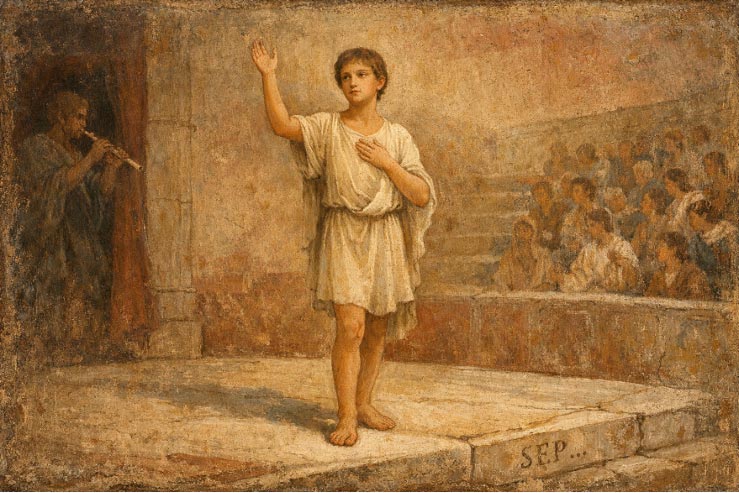
in the style of the 3rd century; below, another, more fanciful representation at the court of the emperor [SC 2026].
Among the forms of entertainment that existed in the Roman Empire during the 2nd and 3rd centuries, spoken or sung theatre (in Latin or Greek) was an elite art form, intended for a learned audience capable of understanding a sophisticated literary language. Another genre, however, was far more popular: pantomime. It was a form of musical and dance theatre, entirely mimed—highly sensuous and immediately accessible to all [7]. The term comes from the Greek παντόμιμος, meaning a performer capable of imitating everything.
The principle was as follows: a single principal dancer performed all the roles—he was the star. He changed masks according to the character and narrated the story solely through gestures and dance[8]. He was accompanied by musical instruments (flutes, percussion), often by a chorus, and sometimes by a narrator. In all cases, the dancer translated the text into movement. The subjects were almost always drawn from mythology: such stories were ideal for dancing, as they involved extreme passions, transformations, and powerful dramatic momentum. Performances took place in theatres, during religious festivals, or as part of public games.
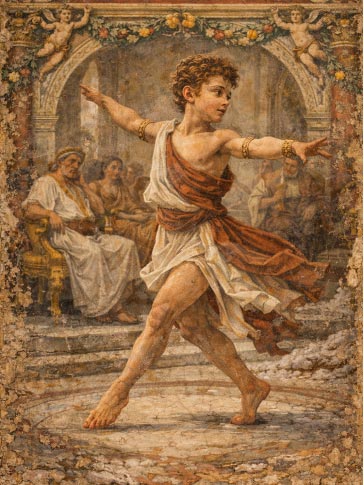
Those performers were true imperial celebrities. They could earn huge sums of money, be idolized by crowds, and inspire rivalries among supporters. Sources even recount riots between fans of different dancers. That is why the term “pop star,” mentioned previously, perfectly corresponds to the status of the great Marcus Aurelius Agilius Septentrio as well as that of our young Septentrio.
Despite their fame, pantomime performers retained a low legal status. They were often enslaved or freedmen, and were legally classified among the “dishonourable professions”. Yet their success could grant them considerable influence: some became very wealthy or closely connected to power.
Although pantomime was extremely popular, it was also sharply criticized. Some moralists condemned the excitement of the crowds, the eroticism of some dances, and the corrupting influence of performers on the public. These criticisms notably inspired Lucian of Samosata (c. 120–180 CE) to compose The Dance, a dialogue in which he examines the arguments for and against pantomime and presents himself as a defender of the art. He talks passionately “about dancing and about its good points, showing that it brings not only pleasure but benefit to the public, that it teaches us lessons, that it infuses harmony into the souls of its spectators, exercising them in seeing beauty, entertaining them with smooth harmonies, and unveiling the links between physical and moral beauty [9]”.
4. Frozen Flames
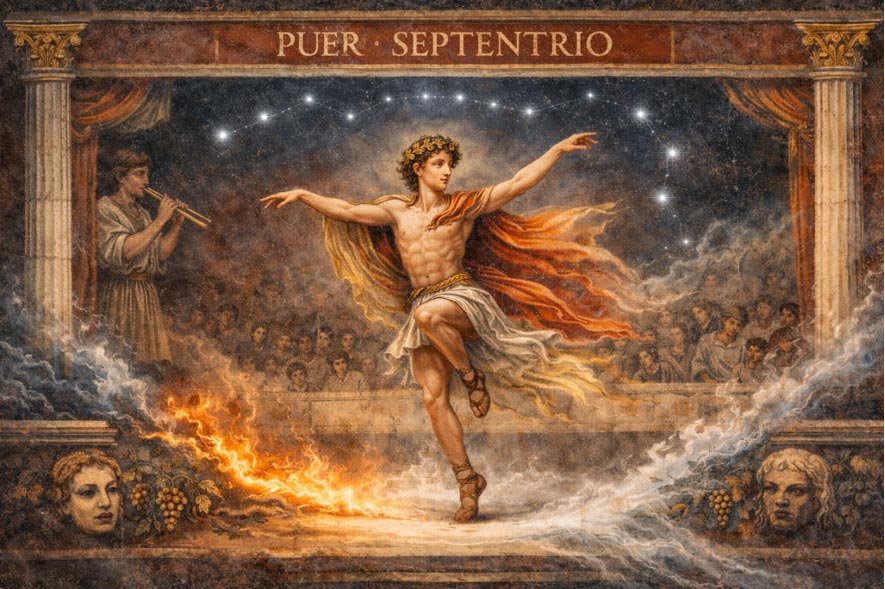
Frozen Flames… what a striking oxymoron! “That is, hot ice and wondrous strange snow,” as spoken by the Greeks in William Shakespeare! As mentioned at the beginning of this article, Armas Launis reconciles opposites here, just as he did in his own life; this opera, his swan song, brings together the Mediterranean sun with the stars of the North and the aurora borealis. The symbolism of the stars and heavens forms the foundation of this opera-ballet, particularly that of the Sun—whether through its omnipresence during the bright summer nights (Scene 6: “The Land of Bright Nights”[10]) or its absence in winter, beneath the northern lights (Scene 7: “Frozen Flames”; these two scenes forming the core of the opera). It is the North as dreamed of in exile, a land of extremes and oxymora, in contrast to the temperate Mediterranean world.
A seasoned ethnomusicologist, Launis makes use of “melodic motifs drawn from the musical folklore of Provence and Scandinavia, to provide the appropriate colour for certain situations. One cannot claim that these present-day melodies were sung in Antiquity in those regions. But neither can one say that they are not an ancient heritage that still persists today. In Provence, there survives a finger game played by two people, mourra, which was also known to the Romans as micare digitis.” [11]
And the composer concludes his note of intent with a nostalgic and deeply personal sigh: “One may suppose that the poor, suffering Septentrion longed for his native land, which had left many memories in his mind.” [12]
Today, sixty-nine years later, Launis’ “poor Septentrion” returns to his native land—the country of bright nights and frozen flames—thanks to the premiere now presented atTapiola Church.
Sources
Lucian of Samosata, “The Dance“ [c. 163-166 AD], in Lucian, Vol. 5. translated by Austin Morris Harmon. London: William Heinemann, Ltd.; Cambridge, MA: Harvard University Press, 1936. https://atlas.perseus.tufts.edu/library/urn:cts:greekLit:tlg0062.tlg045.perseus-eng2/
Gabriel Simeoni, Les illustres observations antiques du seigneur Gabriel Symeon, Florentin, en son dernier voyage d’Italie l’an 1557, Jean de Tournes, Lyon, 1558. https://gallica.bnf.fr/ark:/12148/bpt6k8555485
Armas Launis, Jäiset liekit – Les flammes gelées – Stella borealis [Finnish-French bilingual libretto], typescript, 1957, 31 p.
Jean Christian Dumont & Marie-Hélène François-Garelli, Le théâtre à Rome, LGF, Paris, 1998.
Pascal Colletta, La Mourra bella – Histoire et histoires d’un jeu interdit, SERRE, Nice, 2006; and La Mourra – Plus qu’un jeu, un des piliers de notre culture, Mémoires Millénaires, Saint-Laurent-du-Var, 2020.
Ruth Webb, Demons and Dancers – Performance in Late Antiquity, Harvard University Press, Cambridge ma & London, 2008, especially p. 58-94.
Giulia Filacanapa, Guy Freixe and Brigitte Le Guen (ed.), Le masque scénique dans l’Antiquité – pratiques anciennes et contemporaines, Éditions Deuxième Époque, Montpellier, 2022.
“Autour de la stèle de Septentrion”, Musée d’archéologie, Antibes [“atelier-kit” uploaded in October 2024], 10 p. https://fr.calameo.com/antibes-juanlespins/read/002074504667314812857 (viewed 18.01.2026)
[1] Simeoni 1558, p. 26 :
[2] The number 1 is still visible today on the right-hand side.
[3] After the death of Armas Launis, a new museum was established in Antibes in 1963, with the aim of gradually transferring the archaeological collections from the Château Grimaldi. It is now the Musée d’Archéologie d’Antibes, where the stele of Septentrion has been on display since 2002.
[4] The photograph reproduced here is taken from the typescript libretto of Frozen Flames.
[5] Finnish version by Launis: “Kaksitoista vuotiaan pojan, Septentrion hengille, joka esiintyi kahtena päiväna Antipoliksen teatterissa ja herätti mieltymystä.” (Epigraph to Frozen Flames.)
[6] Finnish version by Launis : «Hänelle annetusta orjannimestä päättäen hän oli pohjoismaista sukua kuuluen ehkä Skandinavian suomalais- tai germaanilaissukuisiin viikingeihin, jotka olivat vilkkaassa meriyhteydessä Bretagnen kanssa, ja jotka yhä edelleenkin jatkavat ikivanhaa kaupallista toimintaansa, ja joiden jälkeläisiä tekijäkin on. » (Author’s note to Frozen Flames)
[7] Anecdote reported by Lucian (p. 268-269): “One of the barbarians from Pontus, a man of royal blood, came to Nero on some business or other, and among other entertainments saw that dancer perform so vividly that although he could not follow what was being sung—he was but half Hellenised, as it happened—he understood everything. So when it came to be time for him to go back to his own country, Nero, in saying good-bye, urged him to ask for anything that he wanted, and promised to give it him. “If you give me the dancer,’ said he, “you will please me mightily!” When Nero asked, ‘What good would he be to you there?’, he replied, ‘I have barbarian neighbours who do not speak the same language, and it is not easy to keep supplied with interpreters for them. If I am in want of one, therefore, this man will interpret everything for me by signs.’ So deeply had he been impressed by that disclosure of the distinctness and lucidity of the mimicry of the dance.”
[8] Another anecdote reported by Lucian (p. 270): “In that connection I should like to tell you something that was said by another barbarian. Noticing that the dancer had five masks ready—the drama had that number of acts—since he saw but the one dancer, he enquired who were to dance and act the other roles, and when he learned that the dancer himself was to act and dance them all, he said; ‘I did not realise, my friend, that though you have only this one body, you have many souls.’”. “In that connection I should like to tell you something that was said by another barbarian. Noticing that the dancer had five masks ready—the drama had that number of acts—since he saw but the one dancer, he enquired who were to dance and act the other roles, and when he learned that the dancer himself was to act and dance them all, he said; ‘I did not realise, my friend, that though you have only this one body, you have many souls.’” See also Filacanapa et al. 2022.
[9] Lucian, p. 480.
[10] « Öisen valon maa ».
[11] Finnish version by Launis : « Teoksessa on käytetty nykyisen Provencen ja Skandinavian musiikkifolklorea antamaan teoksen eri tilanteille väritystä. Ei voida sanoa, että nämä nykyajan sävelet olisivat jo näin varhain olleet käytännössä asianomaisilla seuduilla. Mutta ei voida myöskään väittää, että ne eivät olisi näin kaukaista perua. Eläähän Provencessa vielä mm. kahden henkilön sormileikki, la mourra, joka oli vanha roomalainen ajanviete, micare digitis. » (Author’s note to Frozen Flames.) On mourra, see Colletta 2006 and 2020.
[12] Finnish version by Launis : « On siis inhimillisesti hyvin uskottavaa, että sairas Septentrio-poloinen kaipasi etäistä kotimaataan, josta hänelle oli jäänyt mieleen monia muistoja. »

